Marketing Automation for Small Teams: Ship Like Ten, Staff of Three
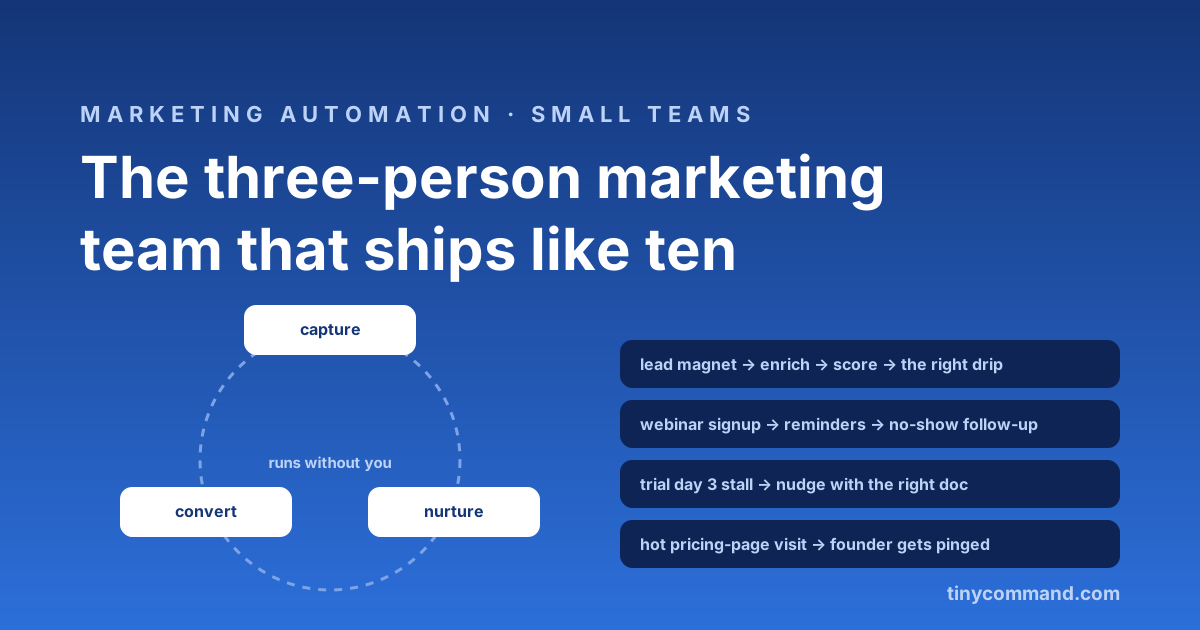
TL;DR: Marketing automation got defined by enterprise suites, which is why small teams either overbuy ($890-a-month platforms) or underbuy (a form, a mail tool, and hope). The middle path is four automations, built in priority order: the capture-to-CRM flow, the welcome sequence, the behavior-triggered nudges, and the hot-signal alert. A three-person team with those four running ships like a team of ten, and none of them needs an enterprise license.
What marketing automation means at small scale
Not 200-step journey maps. It means the repeatable moves between "someone showed interest" and "someone talked to sales or bought" happen without a human pushing each one. The test for what to automate is simple: anything you have done identically three times this month is a candidate, and anything time-sensitive (the fast follow-up, the hot-lead alert) is a priority, because speed is the one thing automation does better than a diligent human.
The four automations, in build order
1. Capture to CRM, with enrichment. Every form (lead magnet, demo request, newsletter) writes to one table, enrichment fills the company picture, and a score sorts the queue. This is the foundation; without it the other three have nothing reliable to act on. The wiring is the first half of our small-business CRM build.
2. The welcome sequence. Three to five emails over two weeks, branching on engagement; the craft is in our email automation guide. Written once, it works every signup forever, which makes it the highest-ROI copywriting a small team ever does.
3. Behavior-triggered nudges. Trial stalled on day three sends the relevant doc. Webinar registrant no-shows gets the recording plus a one-question ask. Pricing page revisited moves the lead up the queue. Each nudge is one trigger, one condition, one send in a workflow.
4. The hot-signal alert. When score crosses the line, a human hears about it within a minute, in Slack, with context. Automation does the watching; people do the closing.
The stack math
The enterprise route prices these four automations at $890 a month before onboarding. The duct-tape route (a form tool, a contact-billed mailer, middleware billing per task) starts cheap and grows a meter on every join. The bundled route runs the capture flow, form- and table-triggered nudges, the alert and the first welcome email on one canvas (forms, tables, workflows, email, agents) at $49 flat; a multi-email welcome sequence that branches on engagement isn't part of it today. The ledger is on the pricing page.
What not to automate yet
Social posting calendars, attribution modeling, and AI-generated content factories all have their day, but they are optimizations on top of a working capture-nurture-convert loop, not substitutes for one. Run the four basics for a quarter first; the data they produce will tell you what deserves automation next, which beats guessing from a feature list.
Marketing automation FAQ
What should a small team automate first in marketing?
The capture-to-CRM flow: every form into one table, enriched and scored. It is the foundation the welcome sequence, nudges, and alerts all depend on, and it removes the most daily manual work per hour spent building.
Do small teams need HubSpot for marketing automation?
Usually not at Professional prices. The four core automations (capture, welcome, nudges, alerts) run on flat-rate stacks for a tenth of the cost; HubSpot earns its bill when you need its attribution depth and ecosystem, not for the basics.
How much does marketing automation cost for a small business?
The honest range is $49 to $150 a month on bundled or duct-taped stacks, against $800-plus for enterprise suites. Watch the meters: per-contact mailers and per-task middleware both grow with your success.
What is the highest-ROI marketing automation?
The welcome sequence, by repetition: written once, it runs for every signup indefinitely. Closely second is the hot-lead alert, because response speed converts better than any copy improvement.