Mailchimp Pricing Explained (2026): You Pay for the List, Not the Sends
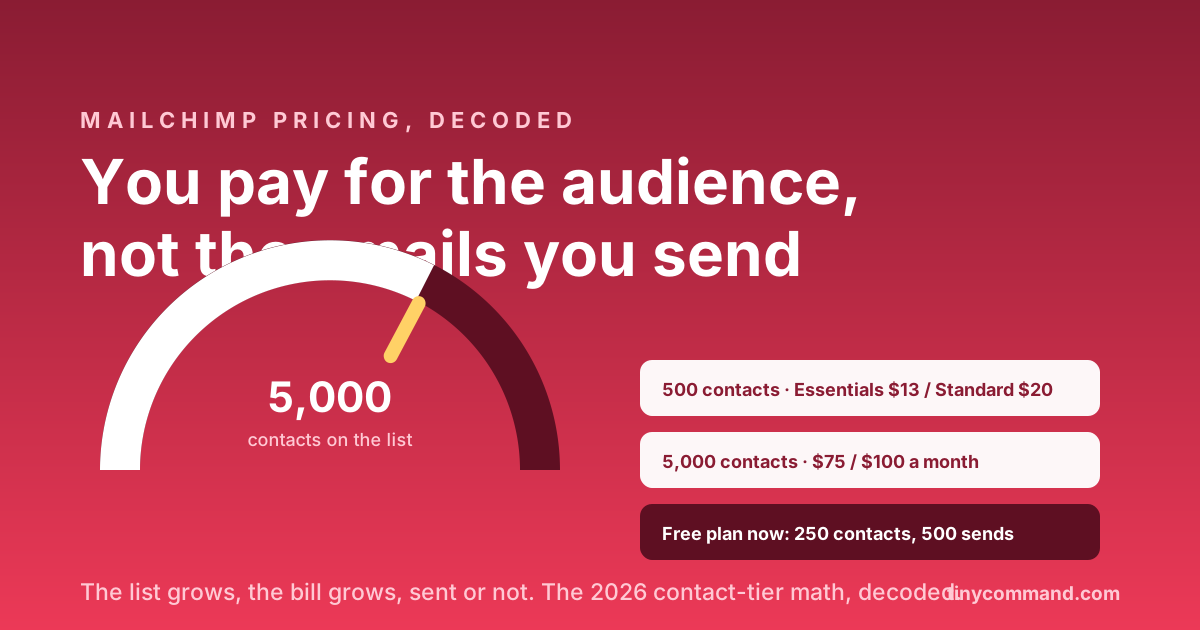
TL;DR: Mailchimp prices by how many contacts sit in your audience, not how much you send. Essentials starts at $13 a month for 500 contacts and Standard at $20; at 5,000 contacts those become $75 and $100. The free plan now covers just 250 contacts and 500 sends a month with a 250-per-day cap. The uncomfortable part: your list usually grows whether or not your results do, so the bill climbs on autopilot. Below, the tiers, the worked math, and the two sane responses.
How the meter works
Every plan carries a contact allowance, and the price steps up as your audience grows. Send one campaign a month or twenty; what moves the bill is list size. Growth-minded teams feel this as a slow squeeze: every lead magnet, every signup form, every imported list nudges the subscription upward. List hygiene (archiving cold contacts) becomes a billing activity, which is a strange incentive for a marketing tool.
The 2026 tiers
| Plan | At 500 contacts | At 5,000 contacts | Worth knowing |
|---|---|---|---|
| Free | $0 (250 contacts max) | n/a | 500 sends/mo, 250/day cap, Mailchimp branding |
| Essentials | $13/mo | $75/mo | Basic automation, A/B testing |
| Standard | $20/mo | $100/mo | Real automation: branching journeys, send-time optimization |
| Premium | from $350/mo (10k) | $350+/mo | Advanced segmentation, phone support |
Standard is the honest tier for anyone doing automation; Essentials exists mostly to make the entry price look small. And the free plan's shrink to 250 contacts quietly turned it from a real starter home into a demo.
The worked example
A newsletter that adds 400 subscribers a month sits at about 5,000 contacts by the end of year one. On Standard that is $100 a month, $1,200 a year, for a list you mail four times a month. Year two, at 10,000 contacts, the same habit costs roughly $1,800 a year. Nothing about your sending changed; the meter did. This is the same success-tax pattern as Zapier's tasks and Klaviyo's profiles, applied to your audience.
Where Mailchimp earns it
Credit where due: Standard's journey builder is capable, the template ecosystem is enormous, deliverability infrastructure is mature, and for commerce brands the integrations run deep. If your email program is the core of your revenue and your list is monetized well per contact, the meter can be a fair trade. Our TinyEmails vs Mailchimp page names those wins plainly.
Response one: move the list somewhere flat
If you are paying list tax on a lightly-mailed audience, flat pricing fixes it directly. TinyEmails designs the broadcasts TinyCampaigns sends inside Tiny Command's $49 plan, where your audience lives in your own tables rather than a billed audience object, and the count does not set the price. Automated multi-email sequences aren't part of it today. The drag-and-drop builder includes AI drafting and merge fields from your live data; the wider switch math is on the pricing page.
Response two: keep Mailchimp, stop paying for the layers around it
Plenty of teams like Mailchimp's sender reputation and templates but pay extra tools to feed it: a form tool for capture, middleware to sync signups, a spreadsheet for segmentation. That stack is replaceable even if the sender is not. TinyWorkflows connects to Mailchimp with 5 triggers and 16 actions: add or update subscribers, manage tags, trigger on new signups. Capture leads with TinyForms (unlimited responses, free), enrich and segment in tables, and push exactly the contacts worth paying for into Mailchimp. Your audience there stays lean, which on a contact-billed tool is the same thing as saving money.
Mailchimp pricing FAQ
How much does Mailchimp cost in 2026?
At 500 contacts: Essentials $13 a month, Standard $20. At 5,000 contacts: $75 and $100 respectively. Premium starts at $350 a month for 10,000 contacts. The free plan covers 250 contacts and 500 sends a month.
Does Mailchimp charge even if I don't send emails?
Yes. Pricing is based on contact count in your audience, so a month with zero campaigns bills the same as a busy one. Archiving inactive contacts is the standard way teams manage the meter.
What happened to Mailchimp's free plan?
It shrank. The 2026 free plan covers 250 contacts and 500 monthly sends with a 250-per-day cap, enough to evaluate the product rather than run a real list on it.
What is the best way to cut a Mailchimp bill without leaving?
Keep only mail-worthy contacts in Mailchimp and run capture, enrichment, and segmentation outside it. TinyForms plus TinyWorkflows (5 Mailchimp triggers, 16 actions) feeds a lean audience automatically inside a $49 flat plan. Tier facts: mailchimp.com/pricing, June 2026.