HubSpot Pricing Explained (2026): The $20 Seat, the $890 Cliff
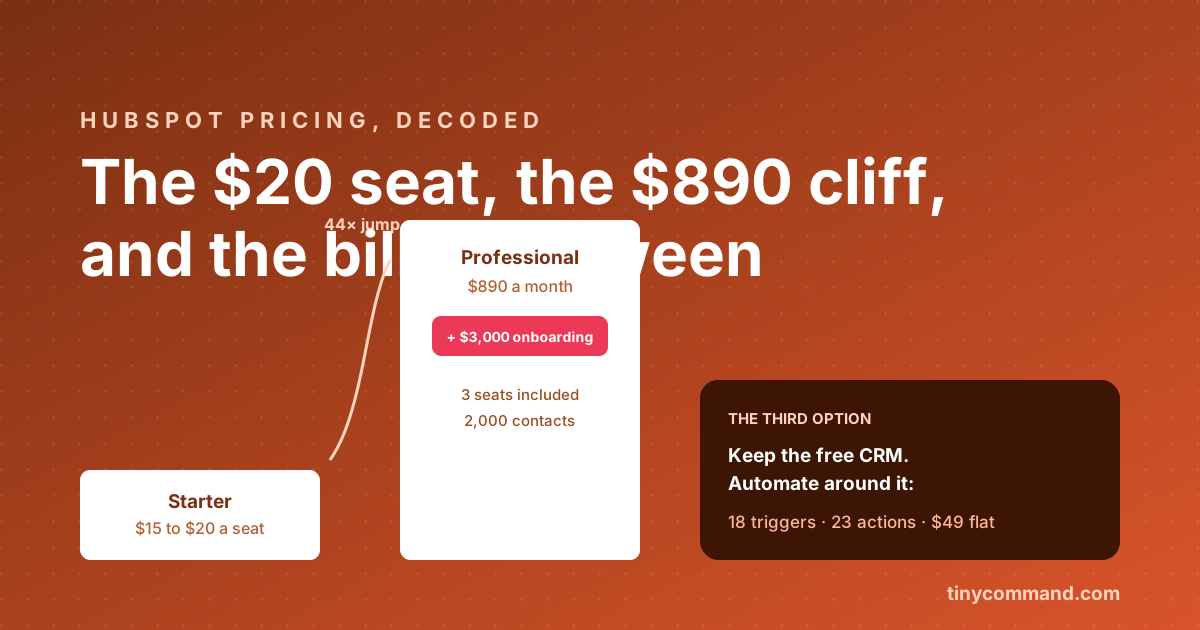
TL;DR: HubSpot's CRM is genuinely free, and the Starter tier is honest value at $15 a seat on annual billing ($20 month-to-month) with 1,000 contacts. The story changes at the next rung: Marketing Hub Professional starts at $890 a month with 3 seats and 2,000 contacts, plus a mandatory $3,000 onboarding fee in year one. That is roughly a 44-times jump. Most teams reading a HubSpot pricing page are really asking what to do about that cliff, so this piece covers the three answers: climb it, leave, or stay on the cheap tiers and automate around them.
The tiers, with the numbers that matter
| Tier | Price (annual billing) | Included | The fine print |
|---|---|---|---|
| Free CRM | $0 | Contacts, deals, basic email | Genuinely useful, HubSpot branding |
| Starter | $15/seat/mo ($20 monthly) | 1,000 contacts | Light automation, simple workflows |
| Marketing Hub Professional | from $890/mo | 3 seats, 2,000 contacts | + $3,000 mandatory onboarding, year one |
| Marketing Hub Enterprise | from $3,600/mo | 5 seats, 10,000 contacts | Extra seats $75/mo |
Two structural notes. Extra full-access seats on Professional run $45 a month each, so a seven-person marketing team adds $180 a month on top of the base. And contacts are their own meter: pass your tier's marketing-contact allowance and the bill steps up again. Seats, contacts, and hub tier all bill at once.
The cliff is the product strategy
The gap between $20 a seat and $890 a month is not an accident. Starter exists to get your data in; Professional is where HubSpot makes its money, and the features that force the jump (real marketing automation, omni-channel campaigns, custom reporting) are exactly the ones growing teams need. By the time you need them, your CRM data, your email history, and your team's habits all live inside HubSpot. The price of leaving is migration; the price of staying is the cliff. That squeeze is the entire economics of the product, and to HubSpot's credit, the product at the top of the cliff is excellent.
Option one: climb it
If marketing is your growth engine, you send serious volume, and attribution reporting pays for itself, Professional can be worth every dollar. A revenue team closing six-figure deals does not blink at $890 a month. Our comparison page is blunt about this: at enterprise marketing scale, HubSpot's depth is the bar.
Option two: leave
Teams that use HubSpot as a glorified contact list plus email sender are paying CRM-platform prices for spreadsheet work. For them, a relational database with enrichment built in, plus email and automation, replaces the actual jobs at $49 flat. That is the standard replace pitch, and for this slice of users it is simply correct math.
Option three, the one nobody writes about: stay and automate around it
Here is the move the cliff-stuck team usually misses. The free and Starter CRM tiers are fine at what they do; what they lack is automation. You do not have to buy HubSpot's automation to automate HubSpot. TinyWorkflows connects to HubSpot with 18 triggers and 23 actions, one of the deepest integrations in our catalog: new contact created, deal stage changed, create or update contacts, manage deals, log activity. The pattern looks like this: keep HubSpot Starter as the system of record ($15 a seat), and run the workflows around it (lead capture that enriches and scores before the contact is created, routing, follow-up emails sent the moment a contact is created) on a $49 flat plan. You get Professional-shaped automation for roughly the price of one extra Starter seat, and your CRM stays exactly where your team already works.
The worked example
- 5-person team on Marketing Hub Professional: $890 a month, $13,680 in year one with onboarding.
- Same team on Starter (5 × $15 = $75) plus Tiny Command ($49): $124 a month, about $1,488 a year.
- What you give up: HubSpot-native attribution reporting and campaign tooling. What you keep: the CRM, the contact timeline, and automation that actually fires.
The same logic applies across this series; see the Zapier task math and Mailchimp's contact tiers for the adjacent meters, and our pricing page for the flat-rate side of the ledger.
Is HubSpot worth it in 2026?
It depends entirely on which HubSpot you are buying. The free CRM is worth it without question — there is no serious alternative at $0 that matches the contact timeline, deal tracking, and email integration. Starter is worth it if you want light automation and your team already lives in HubSpot. The cliff into Professional is worth it only if you send serious email volume, need campaign attribution that closes the loop on revenue, and have a marketing function large enough to use the tooling. If the answer to any of those is no, the cliff is not worth climbing — and the workaround in the next section usually replaces the specific jobs you were going to climb for.
Is HubSpot worth it for small businesses?
Yes, at the Free and Starter tiers. Small businesses get a real CRM, basic email, and light automation for $15 a seat — that is competitive with anything else in the market at that price point. The question becomes complicated when you hit 1,000 contacts or need real automation flows; at that point the math in the Option Three section above typically wins.
HubSpot pricing FAQ
How much does HubSpot cost per month in 2026?
The CRM is free. Starter runs $15 per seat per month on annual billing or $20 month-to-month with 1,000 contacts. Marketing Hub Professional starts at $890 a month with 3 seats plus a $3,000 one-time onboarding fee, and Enterprise starts at $3,600 a month.
Why is HubSpot Professional so much more expensive than Starter?
Professional is where full marketing automation, omni-channel campaigns, and custom reporting live. The roughly 44× price jump reflects HubSpot's strategy: Starter captures your data cheaply, and the features growing teams eventually need sit above the cliff.
Is the HubSpot free CRM actually free?
Yes, and it is good. Contacts, companies, deals, and basic email with no time limit. The costs start when you need automation, remove branding, or pass contact allowances.
Can I keep HubSpot and still avoid the Professional price?
Often, yes. Keep the free or Starter CRM as your system of record and run automation around it through an integration platform. TinyWorkflows connects to HubSpot with 18 triggers and 23 actions inside a $49 flat plan, which covers most of what teams actually climb the cliff for. Pricing facts: hubspot.com/pricing, June 2026.