Notion Pricing Explained (2026): Per Member, Plus the AI Line
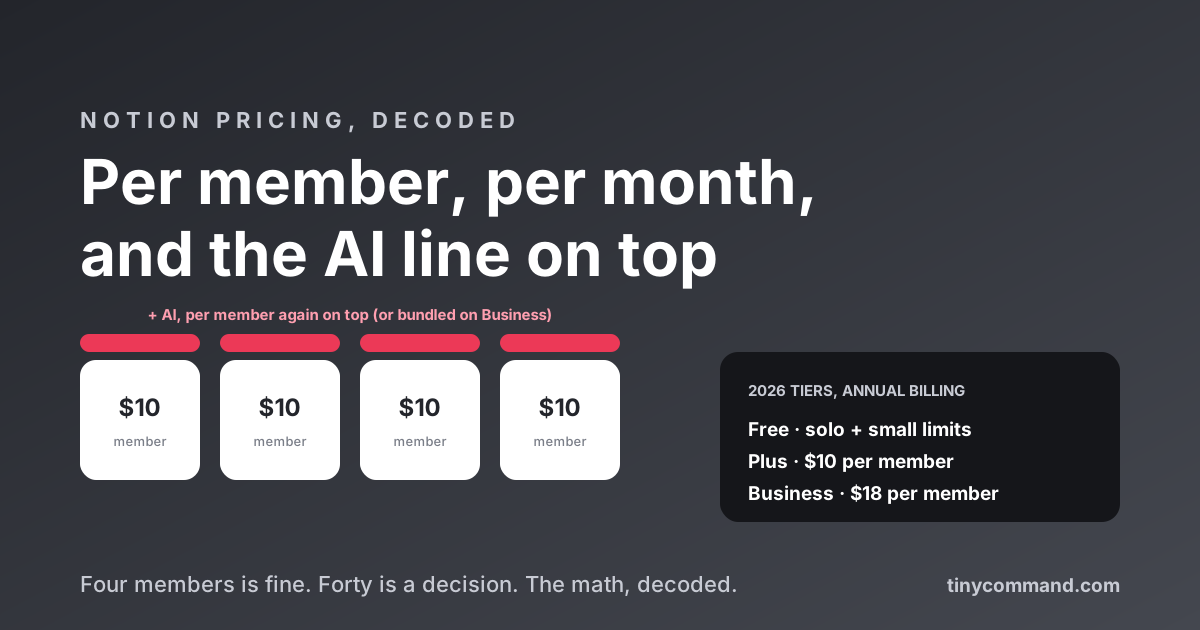
TL;DR: Notion's 2026 pricing is clean by SaaS standards: Free for personal use, Plus at $10 per member a month on annual billing, Business at $18 with Notion AI bundled, Enterprise by sales call. The two things to actually model are member count (every editor is billed, and workspaces accumulate members the way drawers accumulate cables) and the AI line, which on lower tiers prices per member again on top. Clean does not mean small once a whole company lives in it.
The tiers, briefly
| Plan | Per member / month (annual) | What you get |
|---|---|---|
| Free | $0 | Personal use, small block limits for shared spaces |
| Plus | $10 | Unlimited blocks for teams, file uploads, 30-day history |
| Business | $18 | Notion AI included, SAML SSO, private teamspaces, 90-day history |
| Enterprise | custom | Advanced controls, audit log, dedicated success |
Monthly billing prices each tier higher, and Notion AI as an add-on historically ran about $8 to $10 per member on plans where it is not bundled, which is why Business at $18 with AI included is the tier Notion steers teams toward. The math favors it the moment half your members want AI.
The two meters that actually move the bill
Members. Everyone with edit access is billed. Notion workspaces sprawl by design (docs, wikis, databases, meeting notes), so member counts creep: the contractor, the part-timer, the founder who edits one page a quarter. Twenty members on Business is $4,320 a year. Guests are the loophole: external collaborators on specific pages are free within limits, so disciplined teams keep clients and freelancers as guests, not members.
What Notion is genuinely best at
As a connected workspace for documents, wikis, and light databases, Notion has no equal at its price. The block model is elegant, templates are everywhere, and adoption is effortless because half your hires already use it personally. Our TinyTables vs Notion page says it outright: for knowledge and docs, choose Notion.
Where per-member pricing stops making sense
The strain shows when Notion databases get asked to be operational systems: CRMs, trackers, intake queues. Notion databases are pages wearing a table costume; they lack real automation depth, enrichment, and the relational guarantees ops work needs. Paying $18 a member so forty people can read a tracker is the specific bill that makes teams look around. The split that works: keep Notion for knowledge, run operations on a real database with enrichment built in, where Tiny Command's $49 flat plan covers the team without per-member math.
Or keep everything in Notion and automate around it
The augment path works here too. TinyWorkflows connects to Notion with 3 triggers and 12 actions: create and update pages and database rows, react to changes. The common pattern: TinyForms capture (unlimited responses) writes clean rows into a Notion database, with enrichment and routing handled in the workflow before anything lands. Your members read tidy data; your bill stays at the member count you already had. The flat side of the comparison is on the pricing page, and the rest of this series (HubSpot, Monday) covers the adjacent per-seat meters.
Notion pricing FAQ
How much does Notion cost per user in 2026?
Plus is $10 per member per month on annual billing; Business is $18 with Notion AI bundled. Monthly billing runs higher, and Enterprise is custom. Personal use stays free.
Is Notion AI included in the price?
On Business and above, yes. On lower tiers it has been a separate per-member add-on, which is exactly why the Business tier is positioned as the default for teams that want AI.
Do Notion guests cost money?
No, within limits. Guests invited to specific pages are free, while full members are billed. Keeping clients and contractors as guests is the standard way to control the member meter.
When should I move a Notion database to a real database tool?
When it becomes operational: lead tracking, intake queues, anything needing automation, enrichment, or thousands of rows. Keep Notion for docs and knowledge; run ops on a flat-rate database like TinyTables. Tier facts: notion.com/pricing, June 2026.