Make vs Zapier (2026): The Cheaper Canvas or the Easier Ladder
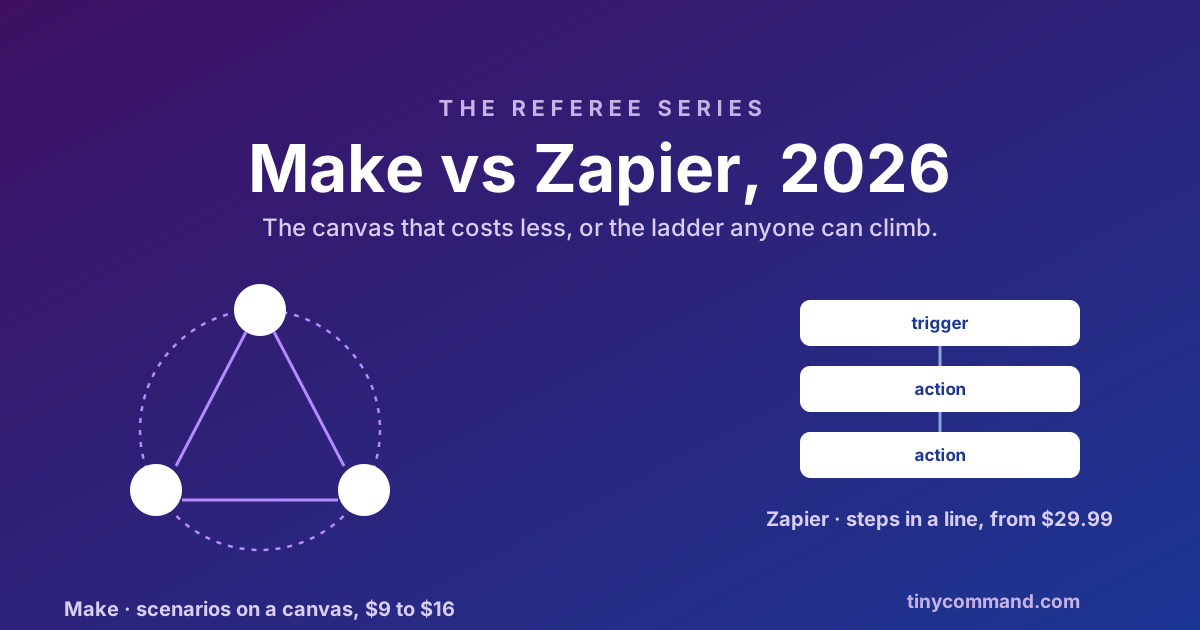
TL;DR: Make is the value pick: paid plans start at $9 a month with 10,000 credits, and its visual canvas handles branching and complex scenarios more gracefully than Zapier's linear steps. Zapier is the accessibility pick: a bigger app directory (~8,000), a gentler editor, and the ecosystem every tutorial assumes. Price favors Make roughly 3-to-1 at entry level. Ease favors Zapier just as clearly. The verdict, as usual, depends on who is doing the building.
The pricing gap, in plain numbers
Both meter usage, but the meters differ. Zapier counts tasks (every action step). Make counts credits, where a standard module operation costs one credit and heavier AI or code steps cost more.
| Make | Zapier | |
|---|---|---|
| Free tier | 1,000 credits/mo | 100 tasks/mo, 2-step Zaps |
| Entry paid | Core · $9/mo · 10,000 credits | Professional · $29.99/mo · 750 tasks |
| Next tier | Pro · $16/mo | $49/mo annual · 2,000 tasks |
| Teams | $29/mo | from $103.50/mo |
| Annual discount | ~15% | large; monthly billing is ~50% dearer |
Read the entry rows side by side. Make's $9 buys 10,000 operations; Zapier's $29.99 buys 750 tasks. Even granting that credits and tasks are not perfectly equivalent units, the gap is not subtle. For workflows of similar shape, Make routinely lands at a third of the Zapier bill or less. Our Zapier pricing teardown shows how fast task math escalates; Make's credit math escalates too, just from a much lower floor.
Where Make is better
- Price, as above. The most automation per dollar of any major hosted tool.
- The canvas. Scenarios are drawn as a visual graph: branches, routers, iterators, and error handlers you can see. Zapier added paths, but Make was born for them.
- Granular control. Data mapping, array handling, and per-module settings go deeper before you hit a wall.
Where Zapier is better
- The first hour. Zapier's editor reads like a sentence: when this, do that. Make's canvas asks you to think like a flowchart, and its terminology (scenarios, modules, bundles) adds a vocabulary lesson.
- Coverage. ~8,000 apps against Make's ~2,000. The long tail matters exactly when your stack contains it.
- The paved road. More templates, more tutorials, more colleagues who already know it. Boring advantages compound.
The verdict, by builder
| You are | Choose | Because |
|---|---|---|
| Budget-conscious and a bit technical | Make | 3× the automation per dollar, and the canvas rewards the learning curve |
| Non-technical, need it working today | Zapier | Easiest editor in the category, everything documented |
| Complex branching scenarios | Make | The graph model fits; linear steps fight you |
| Automating your own forms, data, and email | a bundled stack | Both tools are middleware; sometimes the glue is the cost |
On that last row: the most common scenarios on either tool connect a form, a spreadsheet, an email, and a chat ping. TinyWorkflows ships those as native nodes on one canvas with the form builder, database, AI agents, and email already attached, for $49 flat. The honest split: keep Make or Zapier for long-tail third-party apps; stop paying a separate meter to move your own data between your own tools. Both our Make comparison and the alternatives roundup name the cases where the middleware tools still win.
Make vs Zapier FAQ
Is Make really cheaper than Zapier?
At entry level, clearly: $9 for 10,000 Make credits versus $29.99 for 750 Zapier tasks. The units differ (credits per module operation vs tasks per action step), but for similar workflows Make usually bills a third or less.
Is Make harder to learn than Zapier?
Yes, moderately. Make's visual canvas and vocabulary take a few hours where Zapier takes minutes. Past the first week, many builders prefer the canvas for anything with branches.
Which connects to more apps, Make or Zapier?
Zapier, at roughly 8,000 versus Make's roughly 2,000. Both cover the mainstream; the difference shows in niche or regional tools.
When is neither Make nor Zapier the right answer?
When the workflow is your own stack talking to itself. A platform that bundles forms, database, workflows, agents, and email (Tiny Command runs $49 flat) removes the middleware layer those meters bill for. Pricing sources: make.com/pricing and zapier.com/pricing, June 2026.