NPS Surveys: One Question, One Number, and the Loop That Earns It (2026)
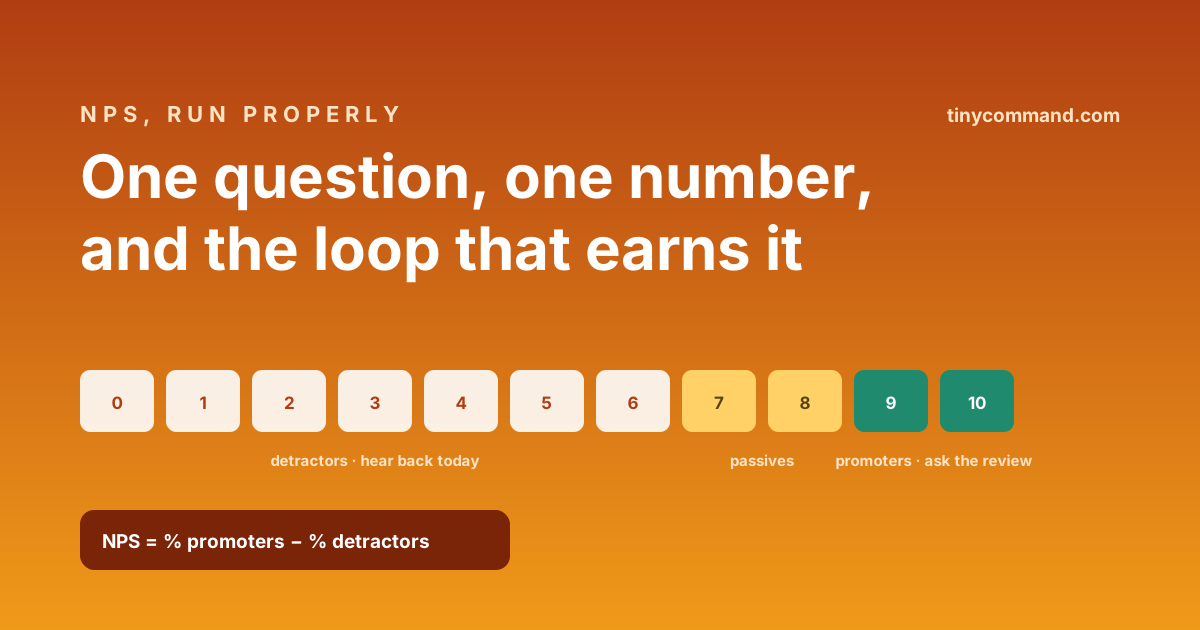
TL;DR: NPS asks one question (how likely are you to recommend us, 0 to 10) and computes one number: the percentage of promoters (9 to 10) minus the percentage of detractors (0 to 6). Sevens and eights are passives and count for neither. The score is a relationship thermometer, useful quarterly and useless as a daily dashboard. What makes the program valuable is never the number; it is the loop: detractors hear from a human within a day, promoters get the review ask while the goodwill is warm.
The mechanics, precisely
Two questions, in this order. "How likely are you to recommend us to a friend or colleague?" on a 0-to-10 scale, then "What is the main reason for your score?" as optional open text. Scoring: promoters are 9 and 10, passives 7 and 8, detractors 0 through 6. NPS = %promoters − %detractors, a number from −100 to +100. A 60% promoter, 25% passive, 15% detractor split is an NPS of 45. The open "why" is where the value lives; the number alone tells you something moved without saying what. The full metric-matching logic (when NPS versus CSAT versus CES) is in our customer feedback survey guide.
When to send, and to whom
Quarterly to a rotating slice of active customers beats annually to everyone: you get a continuous read without surveying anyone twice in a year. Trigger relationship NPS on rhythm, not on events (post-support is CSAT territory), and give new customers at least one full usage cycle before asking; an NPS from someone three days in measures onboarding, not loyalty. In-product asks outperform email roughly threefold on response, and a two-tap survey from TinyForms embeds wherever your product lives.
Reading the number without fooling yourself
Above 0 means more advocates than critics; above 30 is solid for most B2B; above 50 is excellent; above 70 is rare air. But benchmarks vary so much by industry and survey channel that your only trustworthy comparison is your own trend line, same method, quarter over quarter. Segment before celebrating: an NPS of 40 that is 70 among small accounts and −5 among enterprise is not a 40, it is two stories and an action plan.
The loop is the program
Wire three branches in the workflow before sending anything. Detractor (0 to 6): a human reaches out within a day, because a rescued detractor becomes your loudest advocate and an ignored one becomes a public review. Promoter (9 or 10): the review or referral ask, same hour, while the warmth is real. Passive: a one-question follow-up about the single thing that would make it a nine. The question bank for those follow-ups is in our 50-question collection, and pre-built NPS forms with the branching wired live in the templates gallery.
NPS survey FAQ
What is a good NPS score?
Above 0 means net advocacy; 30-plus is solid, 50-plus excellent, 70-plus exceptional. Cross-industry comparisons mislead, so treat your own quarter-over-quarter trend, measured the same way, as the only benchmark that matters.
How often should I send an NPS survey?
Quarterly, to a rotating sample of active customers, so the read is continuous but no individual is asked more than once or twice a year. Event-triggered moments belong to CSAT and CES instead.
Why are 7s and 8s not counted in NPS?
They are passives: satisfied, unenthusiastic, and statistically likelier to churn than promoters. Excluding them sharpens the score into advocates minus critics, which is the contrast the metric exists to measure.
What should happen after someone answers an NPS survey?
Routing, automatically: detractors to a human within a day, promoters to a review or referral ask within the hour, passives to a one-question follow-up. A score collected without that loop is trivia.