AI Model Lock-In Is the New Platform Risk
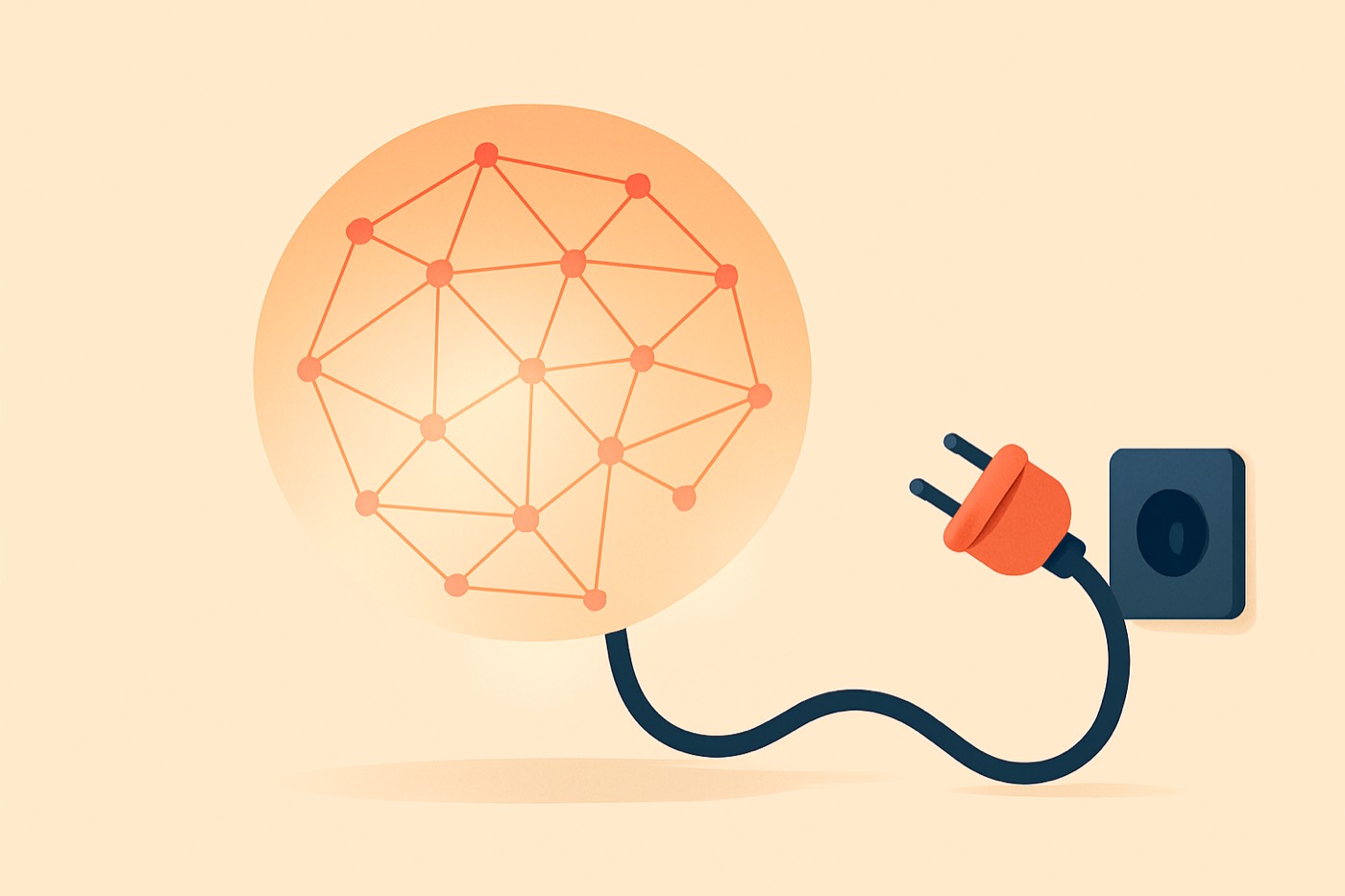

A US export order switched off Anthropic's two strongest models overnight. The lesson here isn't about Anthropic. It's about how much of your product you've quietly handed to a single model you don't own.
TL;DR. On June 12, 2026, a US government directive forced Anthropic to disable Fable 5 and Mythos 5 for every customer worldwide, not for a bug, but for a policy reason no SLA covers. AI model lock-in is the dependency that builds up when your product is wired to one model's API, behavior, and quirks. The fix is architectural: own the prompts, data, and logic, and keep the model swappable underneath.
The story so far. This didn't come from nowhere. Earlier in 2026 the Trump administration labeled Anthropic a "supply chain risk" and ordered federal agencies to stop using Claude after the company refused unrestricted military use. Anthropic sued, and a judge paused the ban in March. The June export order is the next round of a fight that was already months old.
On June 12, 2026, the US Commerce Department sent Anthropic a letter. By the next day, two of the best AI models in the world were gone. Not deprecated. Not rate-limited. Switched off for every customer on the planet. If you build on AI, that single fact should reset how you think about model lock-in, because it just stopped being a hypothetical.
The order named Fable 5 and Mythos 5. Citing national security and export-control authority, the government told Anthropic to cut access for any foreign national, inside or outside the United States, down to Anthropic's own foreign-born employees. There was no clean way to comply halfway, so the company disabled both models for everyone. Fable 5 had been public for a few days.
Anthropic pushed back, publicly and in detail. It said the evidence it received was verbal, that the flagged jailbreak was narrow, and that the same weakness very likely exists in competing models too. Recalling a model used by hundreds of millions of people over one narrow bypass, the company argued, would freeze new releases across the whole industry. You can read their statement and decide who's right.
I don't want to relitigate that fight here. We build on frontier models too, and I have sympathy for everyone in the room. What I want to talk about is the part that should worry founders, and it has nothing to do with whether the government was correct.
What does AI model lock-in actually mean?
AI model lock-in is the dependency that forms when your product is tied to one specific model: its API, its behavior, its quirks, and the prompts and evals you have tuned to match it. The deeper that calibration runs, the more expensive and risky it becomes to switch, even when you suddenly have an excellent reason to.
For years we treated the model layer like electricity. You plug into an API, the smartest system humanity has built answers your call, and you get billed at month end. The mental model was utility: always on, basically interchangeable, somebody else's problem to keep running. June 12 broke that assumption in public.
Your model didn't go down because of a bug or an outage. It went down because of a policy decision made in a building you'll never enter, over a dispute you were never part of.
No SLA covers that. No status page turns green when it's over. And the company you pay couldn't stop it, because the company you pay didn't make the call.
A model can now vanish for reasons that have nothing to do with you
Here is the shift worth naming. Model risk used to mean "the API might be slow." Now it means your single most important dependency can be removed by a third party, on a timeline you don't set, for reasons you can't appeal.
If that sounds dramatic, remember it already happened. It happened to the most safety-focused lab in the field. It happened to its single best product. It happened within about 24 hours. The builders who felt it first were the ones who had wired Fable 5 deep into a live product the week it shipped.
How many ways can a model actually disappear?
More than most teams plan for. The government shutdown is the rare, loud version. The quiet versions happen constantly, cost real money, and never make the news. Here is the full range, sorted by how much control you have.
| How a model vanishes | How often | Who controls it | What it breaks |
|---|---|---|---|
| Deprecation | Routine | Provider, with notice | Prompts tuned to a retired snapshot |
| Behavior drift | Routine | Provider, silently | Eval scores slip with no changelog |
| Policy & refusals | Common | Provider | Prompts that worked in March get refused in June |
| Price & rate limits | Common | Provider | Unit economics, exactly when you scale |
| Regulation & export | Rare | Government | Access by user geography, overnight |
| Full shutdown (Fable 5) | Rare | Government | Everything, for everyone, at once |
Fable 5 sits at the far edge of that table. The rest of it is Tuesday. If your architecture can't survive the routine rows, it had no chance against the last one.
What does AI lock-in actually cost you?
The real cost of lock-in is behavioral, not contractual. You don't just call a model. You tune your prompts to its quirks, build your evals around its strengths, and shape your guardrails and fallbacks around one system's personality.
By month six, "switch providers" no longer means changing a string. It means re-earning months of quiet calibration, and learning which of your features only ever worked because that one model was unusually good at them. The switching cost you can see in a contract is the small part. The part hiding in your prompt files is the expensive one.
A widely shared thread in r/LocalLLaMA put the reaction bluntly the night the order dropped: this is exactly why people want models they can actually hold. You can think running everything locally is overkill and still see the point underneath. The further the brain of your product sits from your control, the more of your roadmap is hostage to someone else's week.
So how do you reduce AI model lock-in?
You stop letting any single model define your product, and you own the layer above it. Picking a "safer" provider is the wrong lesson, because no provider is immune to deprecation, regulation, or a bad policy week. Resilience is an architecture decision, not a vendor decision.
In practice, owning the top layer means four things:
- Abstract the model behind your own interface, so swapping the engine is a config change, not a rewrite.
- Keep more than one provider wired and warm, with automatic fallback when one degrades or goes dark.
- Hold your prompts, logic, and data as portable assets, independent of whatever model runs underneath.
- Run your own evals, so you notice drift before your users do.
This is the principle TinyCommand was built on, and the reason matters more than the pitch. The parts that make your product yours, the workflow, the data, the rules, the agent's instructions, should live with you, while the model stays a component you can replace. The same logic is why teams move automation off single-vendor tools in the first place, the argument I make in the case for tool-agnostic automation. The full build, with fallback patterns and an eval starter, is its own piece: the model-proofing playbook.
Why this keeps happening from here
There is a deeper pattern, and it loops back to how Anthropic ended up in this spot. For more than a year, the leading labs have marketed their models as almost too powerful to release safely and lobbied governments to regulate frontier AI closely. On June 12 a government took both messages at face value and acted. I unpack that irony, and what it signals for everyone downstream, in the companion piece on Anthropic's safety bet.
The takeaway for builders is smaller than the politics. As models get more capable, they get more contested, by regulators, by governments, and by the labs' own safety teams. Capability and controllability are starting to pull in opposite directions, and you sit downstream of that tension whether you planned for it or not.
The takeaway
Three things to carry out of June 12. First, the model layer is now a rented, swappable, politically exposed part, so stop designing as if it were a utility. Second, most lock-in lives in your prompt files and evals, not your contract, which means the time to loosen it is before you need to. Third, resilience is something you architect, not a provider you pick.
Treat the model as what it now demonstrably is. Build the rest of your product to outlive any single one of them, and a morning like June 13 becomes a config change instead of a crisis. If you're still mapping what these systems can do for you, start with what AI agents actually are, then come back and pressure-test your own stack.
Build on AI without betting the company on one model. TinyCommand keeps your workflows, data, and logic yours, and the model swappable underneath. See how it works.
FAQ
What does AI model lock-in mean? It's the dependency that builds up when your product is wired to one specific AI model: its API, its behavior, its quirks, and the prompts and evals you have tuned to it. The deeper that calibration goes, the more expensive and risky it becomes to switch, even when you have a good reason to.
Why was Anthropic's Fable 5 shut down? On June 12, 2026, the US Commerce Department issued an export-control directive ordering Anthropic to block Fable 5 and Mythos 5 for any foreign national, citing national security and a specific jailbreak technique. Rather than partially comply, Anthropic disabled both models for all customers and publicly disagreed with the decision.
Is using a single AI provider risky for my business? Yes, because it concentrates risk you don't control: deprecation, behavior drift, price and rate changes, policy refusals, and now regulatory action. The danger isn't that one provider is bad. It's that your product stops working if that provider becomes unavailable for reasons unrelated to you.
How do I avoid AI vendor lock-in? Own the layer above the model. Abstract providers behind your own interface, keep more than one wired with automatic fallback, hold your prompts, logic, and data as portable assets, and run your own evals to catch drift early. The model-proofing playbook walks through each step.
Did the Fable 5 shutdown affect all Claude models? No. The directive named Fable 5 and Mythos 5. Other models such as Claude Opus 4.8 stayed online, and Anthropic said it was working to restore access to the suspended models as soon as it could.
Sources
- Anthropic, Statement on the US government directive to suspend access to Fable 5 and Mythos 5
- CNBC, Anthropic disables access to Fable 5 and Mythos 5 to comply with government directive
- Fortune, Anthropic disables Fable and Mythos after US bars foreign access
- NBC News, Anthropic suspends new AI models after government directive
- TechCrunch, Anthropic's safety warnings may have just backfired
- The Hacker News, US orders Anthropic to suspend Fable 5 and Mythos 5 for foreign nationals
- 9to5Mac, Anthropic pulls Claude Mythos 5 and Fable 5 following US government directive
- TechRadar, After a potential jailbreak, Anthropic is shutting off Mythos 5 and Fable 5
- AOL, Trump orders federal agencies to stop using Anthropic's AI models
- Yahoo News, Anthropic sues Trump administration over Pentagon blacklisting
- NPR, Judge temporarily blocks Trump administration's Anthropic ban
- Reddit, r/LocalLLaMA community reaction thread